Waken up, you sleepy Christian!

Monday, 21 March 2011
Wedding in Boba
Marina and I attended a Loron wedding in Ivory Coast over the weekend. Donald Pale, a young Loron believer who is training to be a pastor, and Marcel, the daughter of Hovare, one of the first Loron believers, were married in a little village called Boba just a few miles from Gogo. It's the first time we have ever seen a white wedding dress being used in a Loron wedding!


Click on pictures for larger image


Friday, 4 March 2011
There is joy...
… there is joy in the presence of the angels of God over one sinner that repenteth.
Lu 15:10
Almost three years ago we distributed several hundred little solar-powered radios among the Loron people living in the rolling hills of southwest Burkina. Since 2008 we have heard sporadic reports of small groups of Loron folks listening to the chronological Bible lessons, recorded in their own language, that were being broadcast by the local radio station, but we were not aware of any one in particular who wanted to hear more about the gospel.

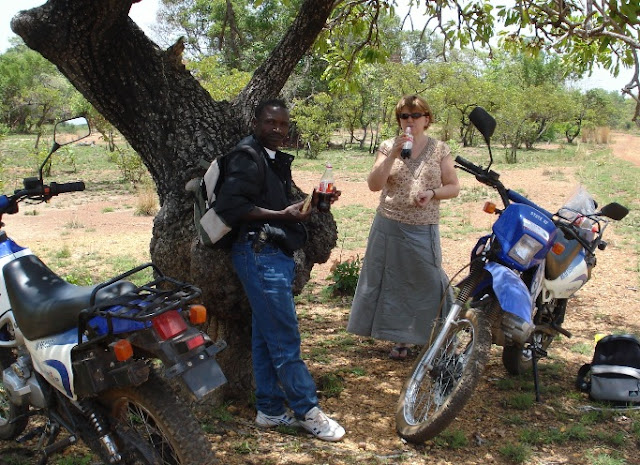
Last Saturday, Marina and I made a special trip into the region to visit three of the villages where we knew people had been listening to the evangelistic Bible lessons on the radio. We arranged for one of the Loron Bible teachers, Joel, to come from Ivory Coast to accompany us to help ‘spy out the land’, looking for openings to begin face-to-face Bible teaching or maybe even to start literacy classes.
We visited the large Loron village of Nyolka - which means ‘Thirsty Place’ - but we were a little disappointed with the response of most of the people there. The chief of the village was quite abrupt with us, which was very unusual for a Loron village leader, and he didn’t really want to spend any time talking with us. The others in the village were clearly intimidated by him. We did, however, get some requests from a few of the young adults for more radios.
The second village was a lot more encouraging. The people in Lata seemed to be a lot more open to hearing more of the Bible teaching and were also interested in the possibility of starting literacy classes. They are going to meet together and arrange another time for us to visit them again with the goal of setting up regular visits.
At the third village, located right down near the border of Ivory Coast, we went to talk with a young semi-educated Loron man who had shown some interest in learning how to teach literacy. As it turned out, he told us that he is a travelling salesman and that he wouldn’t have the time to spend teaching others through the literacy course. As we chatted with him and the other folks in the village, we got talking to a lady who told us that she had become a Christian after hearing the gospel on the little radio we had given to her. Praise the Lord! She has been crossing the border into Ivory Coast to attend a little church there. She brings her children with her. She said that it had been very difficult for her as she is the only Christian in the village. Please pray for Mariam.
Friday, 28 January 2011
25 Years Ago Today

At that moment, we were on an Egypt Air Boeing 737 somewhere over the Mediterranean Sea on our way to Ivory Coast for the first time.
During 1985 there had been a string of airplane hijackings, and about eight weeks before our flight was due to leave for Ivory Coast, an Egypt Air jet was hijacked, and most of the passengers had been killed in a botched rescue attempt in Malta. Although a little anxious, we, nevertheless, decided to go ahead with our flight through Egypt. Although it had doubled our journey time, we had chosen to fly with Egypt Air because some missionaries had recommended it to us as the cheapest way to get to Ivory Coast.
We were travelling with three small children, including Kyle, who was only six months old, but the all-male crews on our Egypt Air flights were very helpful. After a long trip from London, we landed in Cairo just after dark. We carefully descended the airplane steps with the children and in the dim light of the airport apron the first person that we saw on the ground was an Egyptian soldier wearing what appeared to be a Second World War steel helmet. He was holding a Lee-Enfield rifle close to his chest and he looked like he had not shaved for a week.
 |
| Peter (6), Kyle (9 months), Laura (4) in Morofe, Yamoussoukro, early 1986 |
The following morning we went to the airport restaurant for breakfast. The prices were displayed in Egyptian Pounds, so we had no idea what the prices were in Sterling. We asked if they took British pounds, and the person behind the counter nodded, and with a big smile, said, “Oh, yes”. At least, I think that is what he said, because he spoke in Arabic, and at that time, I did not know a word of it! We selected a few basic items of food, just to keep the hunger away. When we got our bill was, it was obvious we had been well and truly ripped off.
We had to sit in the departure terminal for a couple of hours until we could check in our baggage. There were dozens of cats roaming around the terminal, licking crumbs from beneath the tables in the restaurant and searching for food in overflowing rubbish bins. Apparently, in ancient Egypt, cats were sacred. They may still be considered so in Cairo airport. Around noon we finally boarded our next plane and took off from Cairo on the second leg of our journey to Ivory Coast.
Our flight was scheduled to make two short stops in Nigeria before going on to Ivory Coast, so we settled ourselves for the long trip ahead. We flew low over the pyramids, and, apparently to avoid Libyan airspace, we followed the River Nile for a couple of hundred miles south, and then headed west. It was fascinating to see the irrigated fields along both sides of the Nile, but just a mile or so from the water’s edge it quickly became barren and soon there was nothing but sand and desert as far as the eye could see.
 |
| The Plateau, Abidjan |
However, another problem arose. Someone informed the airport authorities in Ivory Coast that our flight had been cancelled, and the missionaries who had gone to meet us at the airport were left in a quandary as what to do. After a brief stop in Lagos in southern Nigeria, and a change of crew, we took off again and finally arrived at Abidjan airport in Ivory Coast just around midnight, several hours late. After gathering together our suitcases, we made our way through customs and then out into the main Arrivals area. As soon as we passed through the exit doors, we came upon a crowd of passengers, who were shouting and pushing and shoving, all trying to grab one of the few taxis left at the airport. We stood off to one side and waited until things quietened down a little, hoping to catch a glimpse of the missionaries who had come to meet us. The terminal soon emptied, but there was no one there to pick us up. The folks who had come for us had gone home, because they had been told that we would probably arrive the next day.
Having delivered their passengers to the city, some taxis started arriving back at the airport. With our limited French we managed to find a taxi driver who spoke a little English and who said he knew the location of the Mission Evangelique in the city. We hired two rickety taxis, and with our windows wide open, we set off into the balmy African night. As we crossed the bridge from the airport over the lagoon to the centre of Abidjan, we marvelled at the skyline, replete with fifteen and twenty-story buildings bedecked on top with huge Nissan and Coca Cola neo signs. Abidjan was a very modern city, boasting the only ice rink in West Africa.
When we arrived at our destination, we discovered that the taxis had brought us to the Mission Catholique. By this time, it was 1:30 in the morning, so we had to return to the airport, where we spent the remainder of the night in the main entrance hall. We tried to make a bed with the suitcases for the children to sleep on. One of the workers at the airport who saw our predicament took pity on us. He brought over some Johnnie Walker Whiskey cardboard boxes and laid them out flat so that the children could sleep more comfortably. Marina and I did not sleep very well that night!
The next morning, with the help of some WEC missionaries, we were able to make contact with our mission guest home. Raymond and Marie Parker, NTM missionaries working in Abidjan, immediately came to rescue us. They were horrified that we had spent the night at the airport, and were very apologetic, but it was not their fault in the least. We spent a couple of very relaxing days with them at the mission guest house, and they showed us some of the many interesting sights in Abidjan.
Sunday, 23 January 2011
Christmas and New Year in NI
We just had a few very enjoyable weeks with family and friends in the UK. We spent most of the time in Northern Ireland, but we also got to spend several days with Kyle and Leanne in Edinburgh, Scotland. We returned to Burkina last Wednesday.
Click on picture for larger image
 |
| Stephanie, Seth, Caleb and Rebecca |
 |
| Seth wasn't quite sure what to make of the snowman! |
 |
| River Bann, Gilford |
 |
| Stephanie and Rebecca |

 |
| Leanne and Caleb |


Monday, 3 January 2011
Visiting Loron Churches
During 2010, Marina and I had the privilege to witness first-hand what the Lord is doing among the Loron people in northern Ivory Coast. There are nine groups of Loron Christians meeting together regularly for worship, Bible teaching and fellowship. Here are a few photographs of the various meeting places and groups of Loron believers.




Friday, 10 December 2010
Disputed Election Results in Ivory Coast

The red/pink regions on the map voted for Ouattara; the blue for Gbagbo
The result of the recent presidential election in Ivory Coast has been
disputed and political confusion reigns in the country.
The Independent Electoral Commission declared Alassane Ouattara
[watara] to be the winner of the poll with 54% of the vote. However,
the current president, Laurent Gbagbo, refused to allow most of the
votes from the northern part of Ivory Coast to be counted, claiming
intimidation, and a constitutional court subsequently overturned the
initial result and declared Gbagbo to be the winner.
The UN, EU, African Union, IMF, World Bank and numerous individual
countries have stated their support for Alassane Ouattara. The Ivorian
military is supporting, at least for the time being, Laurent Gbagbo,
so, he is still the de facto president.
Both Gbagbo and Ouattara have been sworn in as president of the
country and they each have created a government.
Please pray for a quick and peaceful resolution to the current stalemate.
Thursday, 18 November 2010
Crisis in Conakry

What an eventful trip! What started out as a regular 6-monthly, 3-day gathering of NTM’s West Africa leaders in Guinea Conakry ended up taking two full weeks of our time, culminating in a rather tense exit from the country’s capital as widespread political violence swept the city.
On our way to Guinea earlier in the month, Marina and I were held up for several days in Bamako after our flight to Conakry had been cancelled at the last minute. The final round of polling in the presidential election in Guinea was rescheduled to take place on the very day we were supposed to arrive and the authorities belatedly announced that they were closing the airport, so we had to quickly make new plans. We eventually got to Guinea three days late.
We enjoyed meeting the missionaries who work at the MK school and NTM centre and also some of the new NTM folks in Africa who are learning French and African culture. After our committee meetings finished we travelled to a village to visit the missionaries who live among the Baga Fore people. Marina had spent a week with these folks earlier this year, helping them get their literacy programme off the ground. She had really enjoyed her time with the missionaries and wanted to visit them to see how the teaching was progressing. It was a thrill to hear that the first class had completed the course just before our arrival. We had a great time with the two families and single lady as we discussed their plans for Bible translation and starting Bible teaching in the local language. The next day we left their village to return to the Guinean capital, Conakry, for our flight back to Burkina.
The four-hour trip to the capital was rather uneventful, although some of the views, especially the mountains along the road, were quite outstanding. The ‘highlight’ of the journey was when, at a security checkpoint, we were brusquely ordered out of our taxi by a young, over-zealous soldier and told to open our suitcases. I’m not sure what he was looking for, but after a thorough inspection, and satisfied that we had no contraband, we were allowed to continue on our way. For Marina and me, it was no big deal, but our taxi driver was very angry at the way we had been treated.
We wanted to avoid the street demonstrations that been taking place in various parts of the capital since the election had taken place, so we arrived at the airport about 5 hours before our flight was scheduled to leave. We found a couple of seats in the corner of a large, rather dull waiting room on the ground floor and settled ourselves for a long wait.
After about two hours a police officer came over to us and told us that our flight had been cancelled. We were incredulous and wondered what we were going to do. Due to the political tensions in the country we have no missionaries living in Conakry, and we didn’t know where we could go to spend night, so we contacted Idrissa, a Guinean man who helps our missionaries with business in the city. He said that he would come to the airport to get us and help us to find somewhere to stay. We eventually got a room at an Assemblies of God mission station. The French couple in charge of the guesthouse were extremely friendly and helpful. We had a comfortable night, despite several power outages during the night when the fans stopped turning and it got quite warm and sticky.
At 7am the next morning, Idrissa went to the Air Mali office to rearrange our flights. He was first in line and was able to get us seats on a flight apparently going out that afternoon. However, events were taking a nasty turn in the city. Counting of votes from the November 7th poll had been going on for eight days and activists from one of the parties claimed that massive fraud was taking place. They were becoming increasingly angry and frustrated. Just before noon they started to block roads and burn tyres. We were supposed to leave for the airport at 2pm.
The French missionaries at the guesthouse had invited us to their home for lunch. As we sat chatting, we heard a burst of automatic gunfire and then sporadic gunfire echo around the city. Things were getting serious. The French embassy contacted its citizens and told them to remain where they were, including children at a French school.
We phoned Idrissa to try to find out what was happening and he assured us that despite the violence – two people had reportedly been shot dead and many wounded - he would still be able to get us to the airport by avoiding the trouble spots. We assured our French hosts that we would be fine and said that we from Northern Ireland and had some experience with this sort of thing. Nevertheless, we were beginning to wonder if, indeed, we were going to be able to get our flight out of the country.
Idrissa turned up for us a few minutes earlier than planned. We quickly loaded our bags and started our journey through the city to the airport located on the southern end of the Conakry peninsula. The roads, which had been bustling with people and traffic the previous day, were eerily deserted, apart from a few desperate taxi drivers looking for a fare. Idrissa raced along roads and through districts that he knew to be calm, avoiding areas of the city that had seen the worst of the violence. At one junction he showed us a spot where, earlier in the day when he had been going to get our tickets changed, he had seen a man being severely beaten. The whole thing seemed rather surreal.
Thankfully, we soon arrived, without incident, at the airport. We were first in line. Slowly others trickled in from various parts of the city. It was not long until we were all sitting in a beautiful new elevated departure lounge looking out on blue skies and an empty runway. The peace and calm of the air conditioned lounge was in sharp contrast to the heated tempers and high humidity of the rest of the city. We were still not sure for certain that we were going to get out of the city, so it was a relief to see the 50-seater Air Mali Bombardier plane arrive at the airport. The check-in staff promptly set up their stall and the passengers were smoothly and efficiently processed, and we were soon belted in to our seats ready for take-off. Thirty minutes ahead of schedule, the high-pitched engines roared into life and the wheels speedily and gently lifted off the tarmac.
One hour and fifteen minutes later we touched down at Bamako airport in Mali, just in time to get checked in on a connecting flight back to Ouagadougou in Burkina Faso.
Meanwhile, back in Conakry, Idrissa was trying to make his way back home from the airport. Unfortunately, he got caught up in a mob and his car was slightly damaged as he tried to get away. He was able to get to a friend’s house where he parked his vehicle in the courtyard. He remained there until the trouble had passed, and was able to return home later in the evening.
Our connection flight from Bamako to Ouaga was delayed for several hours because they had to replace the plane we were supposed to take, but, eventually, just before 2am, we pulled up in a taxi at the SIM guesthouse in Ouagadougou.
We thank the Lord for His grace and protection. We would ask you to continue to pray for the country of Guinea, and also for the missionaries who live there as they endeavour to bring the light of the Gospel to the unreached people groups in that country.
Saturday, 6 November 2010
Ivory Coast Election Results
Long-awaited presidential elections took place in Ivory Coast last Sunday (October 31).

None of the 14 candidates received over 50% of the vote, so another poll will take place on November 21 between the two candidates who got the most votes in the first round: Laurent Gbagbo, the current president; and Alassane Ouattara, a former prime minister of Ivory Coast.
Over the next couple of weeks the two candidates will be vying for the votes that the third placed candidate, Henri Bedie, received.
We are praying that the second round will be as peaceful as the first; that stability will return to Ivory Coast; and, as a result, normal missionary activity will resume among the many unreached tribal groups in the country.
Saturday, 23 October 2010
IT Workshop in Gogo
Can you believe it? Last week we had our first computer training course in Gogo!
Five literate Loron men and women learned some basic computer skills, working mostly in Word. We were able to rustle up a number of second-hand laptops and we borrowed a small generator and power regulator from the village, and, hey presto, we had afternoon classes up and running.
At the same time we had a week-long seminar for new literacy teachers from a number of nearby Loron villages, and Marina also introduced a new numeracy course to some who had completed the reading course. We had a very tiring but profitable week.
We have now returned to Burkina to wait for the elections results in Ivory Coast at the end of the month. Pray for free and fair elections on October 31.

 |
| Loron Bible teacher, Donald, with his new motor cycle |

 |
| Benoir with his pet monkey |

Subscribe to:
Posts (Atom)